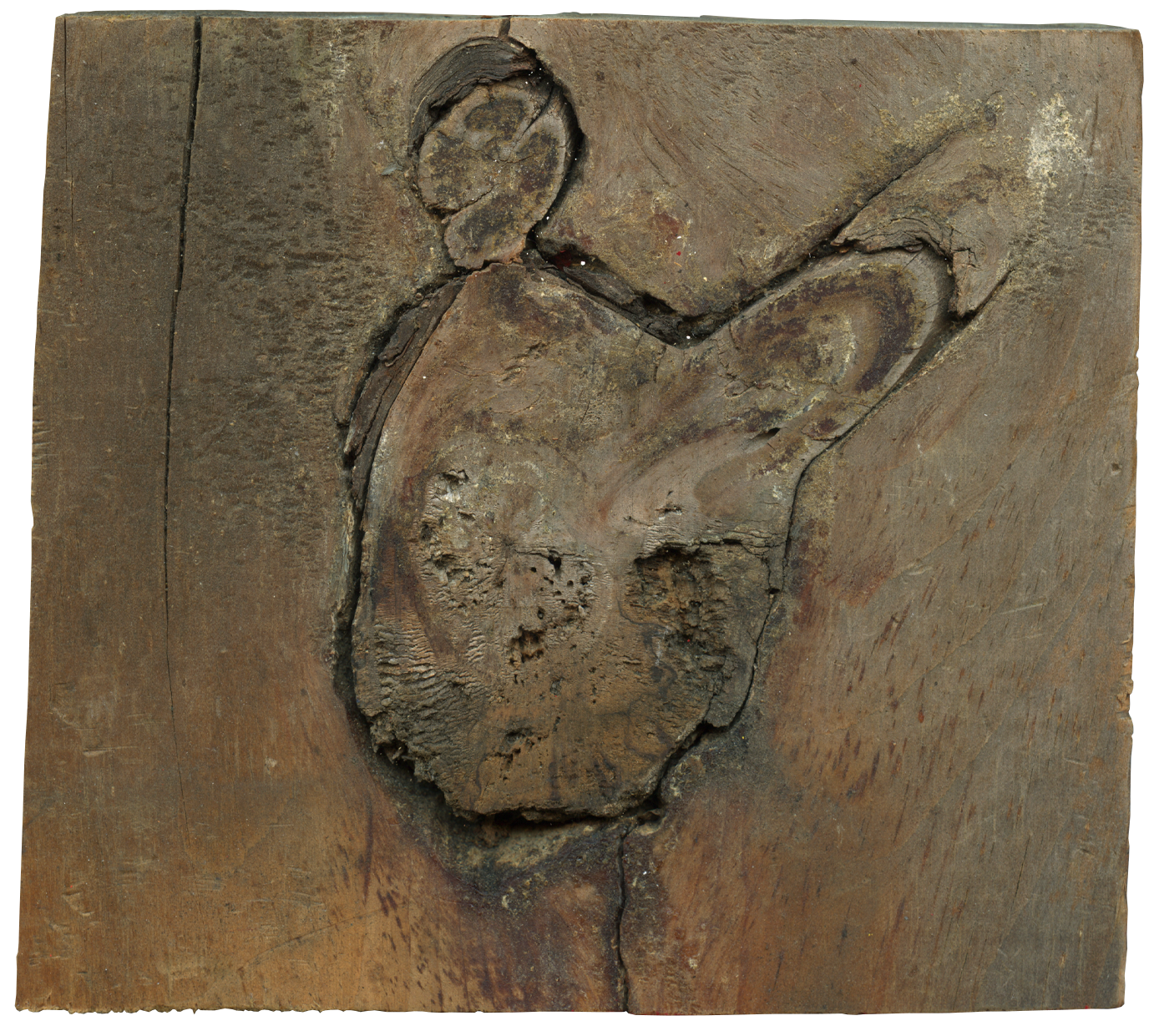
Artifacts
Dean Martineau
On view August 6–30, 2026
Reception August 6, 6pm-8pm
Gallery hours by appointment
Reception photos here
OPEN, 50 Sims Ave
Providence, Rhode Island
openforever.org
Over a century ago, Marcel Duchamp produced the first Bicycle Wheel, an effort he initially called "a distraction." The work, a bicycle wheel mounted upside-down on a stool, might be considered visually naive. Rust-belt lawn decor; something that rattles with the wind. Conceptually though, it raised “Why was this made?” to a level of importance equal to, if not exceeding “How was this made?” Laying the groundwork for conceptual art, Pop Art, and much of postmodernism, the acknowledgment that observation itself modifies objects had parallels in psychology and sociology with the Hawthorne Effect, and in physics with Max Planck's Quantum Theory. This is the POV from which I encountered the work of Providence-based artist Dean Martineau.
Martineau works mainly in painting and assemblage, often with found materials. His subjects are pulled from the headlines—images of war, American flags, celebrity culture; symbols of money, sex, power, and protest. His studio contains all sorts of stuff: gold spray-painted guns, flags, dolls, and pennies; an old fridge missing the door with some basketballs inside; a printout of Ai Weiwei as a cell phone background; a perhaps too-realistic recreation of an IED. It's overwhelming and a bit disorienting, but I found myself grounded by what I’ll describe as a whole bunch of Bicycle Wheel style prototypes.
Everywhere I looked, there was something Martineau had come across, saved, and placed with delicate intention. Some objects stood alone, others were loosely categorized by shape or material. Old nets, tree bark, some pipes, and a catalytic converter, all placed in poetic relation to one another. Imagine a bowerbird that’s got a day job in construction. To be fair to Dean, much of what I’m drawn to in his studio are things he isn’t necessarily seeing as being complete. They are parts of a process and, in time, may get modified. But there’s a historical string going back to Duchamp’s distractions, and with Artifacts Dean is allowing me to press pause for a moment, to acknowledge that through the simple but radical act of noticing, he’s already created quite a volume of interesting material. These objects will be shown alongside paintings, slightly modified pieces, and in all likelihood, some amount of gold spray paint.